
Tenchi Security has released the 3rd edition of our Third-Party Cyber Risk Management (TPCRM) Survey. The report is based on answers provided by cybersecurity analysts, executives, and procurement specialists working in Brazil in November 2025.
You can download the full report here. It includes an introduction to third-party cyber risk management strategies and challenges, as well as a summary of recent major incidents.
This blog post is a selection of highlights and insights based on the same data found in the report.
Key findings
- 84% of respondents cite real-time threat detection as one of the top 3 elements for success in a third-party cyber risk management program. This is difficult in many cases, however, as 45% only carry out assessments no more than twice a year. In other words, the data that nearly half of all businesses use to manage third-party risk can be up to six months old.
- 76% of those that do have a TPCRM program cited self-assessment questionnaires (SAQs) as one of the three tools used to assess a third party's cybersecurity posture, making it the most cited form of assessment. This helps explain why making sure that third parties respond to questions and engage with the TPCRM program is the biggest challenge for 25% of respondents.
- For 37% of respondents, however, the biggest challenge is the lack of visibility over a third party's cybersecurity posture. For instance, 52% lack visibility over cloud environments.
- 38% say that their company is now managing cyber risk for all third parties, and not just critical ones. This number has steadily increased in each edition of the survey, suggesting that TPCRM programs are increasing their coverage.
Methods and tools for third-party cyber risk management
The tools and methods employed by businesses to manage third-party cyber risk provide a glimpse into what TPCRM looks like in the real world, making these findings some of the most important data found in the survey.
Self-assessment questionnaires and security certifications are still the most common means to gather data on how a third-party mitigates cyber risk in its operations.
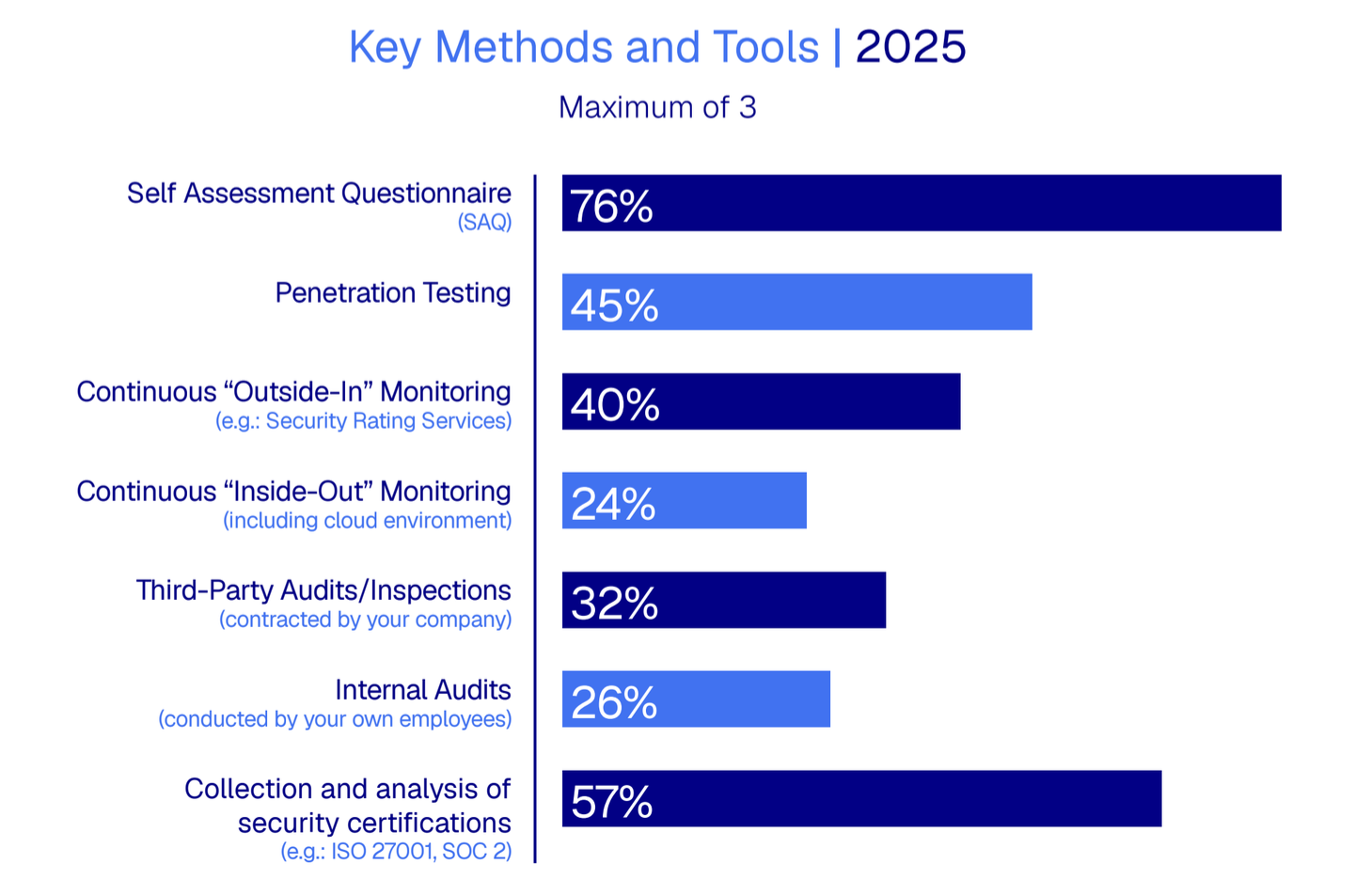
The full report contains a reference chart with the answers from 2023 and 2024, but those should not be compared directly to this more recent data. Participants could only select up to three assessment methods or tools in 2025, while previous editions did not impose any limit.
These numbers are not very surprising, as SAQs and certifications are arguably the most "traditional" approaches to managing third-party risk. Moreover, these methods are not exclusive to cyber risk, reflecting a view that third-party cyber risk management is a governance or compliance issue, with documentation and legal assurances.
The increased exposure to third-party cyber risk is pushing companies to find solutions that are more tuned to the cyber risk part of the equation, though. It's possible to try to improve older methods and automate them (by using GenAI, for instance), or to move towards solutions that were developed for cybersecurity from the ground up (as is the case with continuous monitoring).
Is there a link between tools and assessment frequency?
We observed a link between the tools that businesses use and how often they can assess their third parties.
- When businesses do not use any form of continuous monitoring, only 19% of them manage to assess their third parties weekly or more often.
- When businesses do employ continuous monitoring, this figure increases to 53%.
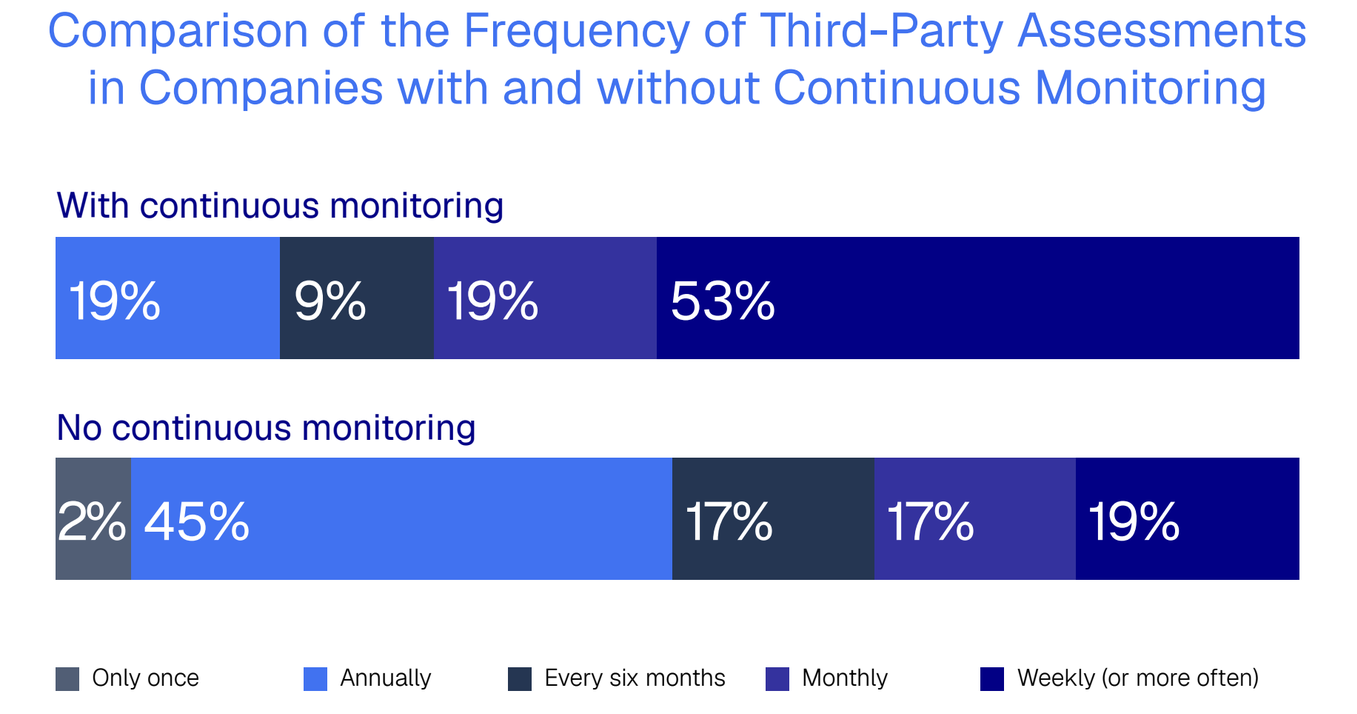
As can be seen in the chart, there is a significant difference between these two groups.
In general, companies that use continuous monitoring tend to have a more up-to-date view of their third parties' cybersecurity posture. The proportion of businesses that perform checks at least monthly (72%) is still twice that of the businesses that don't have a continuous monitoring solution.
To us, this is an indication that the lack of tools for continuous monitoring makes it harder for businesses to evaluate their third parties quickly and efficiently. As such, we see only a third of businesses that don’t employ this technology manage to move beyond two assessments a year.
Continuous monitoring, and especially inside-out continuous monitoring with its higher accuracy and visibility, is a key ingredient for businesses that want to move closer to a real-time view for managing third-party risk.
Cloud visibility and infrastructure priorities
When asked which third-party IT assets or infrastructure should be monitored to manage risk, the three most common answers given by the survey participants were:
- 84%: Cloud infrastructure (including IaaS and PaaS)
- 61%: Software-as-a-service (SaaS) infrastructure
- 55%: Attack Surface Management
As suggested by the numbers, it was possible to select more than one answer. Still, cloud infrastructure was the top choice for 34% of participants.
While "on-premises infrastructure" did not make it into the top 3 when all three choices are considered, it was the top pick for 32% of respondents. It was nevertheless left out of the top 3 because 51% did not select it at all. In other words, while a third of professionals are really concerned with on-premises infrastructure, it is lower priority for most.
Governance, guidance, and incidents
- 69% of companies offer some form of cybersecurity guidance or training to third parties, up from 61% in 2024 and 62% in 2023.
- When companies do offer training, 45% do so more than once a year.
The view that third-party cyber risk management is a compliance or governance problem can be seen in the fact that about 80% of respondents say that their companies make third parties liable for security incidents through a contract clause.
Although there is usually no harm in having this sort of contractual protection, this is not a foolproof solution. For instance, a vendor may be unable to compensate a client for the damage caused by a security incident if it does not have the financial means to do so, or if the incident is so serious it puts the vendor out of business.
Furthermore, an incident can impact IT assets at the first party in a way that the third party cannot be directly held liable for. This can turn into a costly legal dispute that will not fix the operational issues caused by the incident.
Among the respondents of the Tenchi Third-Party Cyber Risk Management Survey that do have a TPCRM program, 46% revealed that their companies suffered at least one security incident in the 24 months preceding the survey. Within this group that reported a security incident, 76% identified at least one incident involving a third party.
Why Brazil?
Businesses face different challenges and constraints that are influenced by the regions in which they operate. We came up with the Tenchi Third-Party Cyber Risk Management Survey to better understand the Brazilian landscape and, by extension, gain insight into how much the region diverges from the global trends found in other surveys.
As we host a yearly event focused on Third-Party Risk Management in São Paulo, we had a great venue to ask local professionals about this topic. This means that the data for this survey is from November 2025.
For the first year, we published a summary of our findings as a blog post. In the second year, we released a full report, which we have done again this year.
We thank all participants for sharing their experiences and making this survey possible. If you haven't downloaded it yet, here is the link to the full report.